Meteor shower calculator
See when the Geminids, Ursids or Quadrantids are well placed from your location. The page shows the radiant height each hour, the moon's phase and rise and set times, a viewing window after moonset or darkness, and an estimated hourly rate.
Some fields were filled from my telescope.
Geminids 2026 peak time and best viewing
The International Meteor Organization lists the 2026 Geminid maximum at 14h UT on 14 December, which is 8:00 a.m. on 14 December in UTC-6 (Alberta Time). The shower is active from 4 to 20 December. The listed zenithal hourly rate is 150. The radiant is at right ascension 112 degrees (7h 28m) and declination +33 degrees.
The official peak falls after sunrise in UTC-6, so the best hours are the night of 13 to 14 December, after evening darkness or moonset, until the start of morning astronomical twilight. For Calgary (51.05 N, 114.07 W), moonset on 13 December 2026 is 10:01 p.m. local time, and morning astronomical twilight begins at 7:30 a.m. on the 14th. Enter your own latitude and longitude to get times in your time zone.
Ursids 2026 peak time and best viewing
The IMO lists the 2026 Ursid maximum at 22h UT on 22 December, which is 4:00 p.m. on 22 December in UTC-6. The shower is active from 17 to 26 December. The listed zenithal hourly rate is 10. The radiant is at right ascension 217 degrees and declination +76 degrees, which stays high for much of the night at mid-northern latitudes. The official peak is in the afternoon in UTC-6, so the nearby nights of 21 to 22 and 22 to 23 December are the ones to check on the calculator.
Quadrantids 2027 peak time and best viewing
The IMO lists the 2027 Quadrantid maximum at 3h 25m UT on 4 January, which is 9:25 p.m. on 3 January in UTC-6. The shower is active from 28 December 2026 to 12 January 2027. The listed zenithal hourly rate is 80, though the true rate can vary. The radiant is at right ascension 230 degrees (15h 20m) and declination +49 degrees. The peak falls in mid-evening in UTC-6, so the night of 3 to 4 January is the one to check for moon height and the dark window from your location.
How the meteor shower calculator works
Choose a shower, enter your latitude and longitude, and pick a date. The page works out the height of the radiant each hour, the moon's phase and its rise and set times, and a viewing window after evening darkness or moonset, until dawn or moonrise. Figures for the peak, rate and radiant come from the International Meteor Organization calendars.
Radiant altitude and direction
The radiant is the point in the sky the meteors appear to come from. Altitude and azimuth use your latitude, longitude and the local sidereal time. Face the compass direction shown; meteors can appear anywhere in the sky. Looking about 30 to 60 degrees away from the radiant often shows longer trails than looking straight at it.
Estimated hourly rate
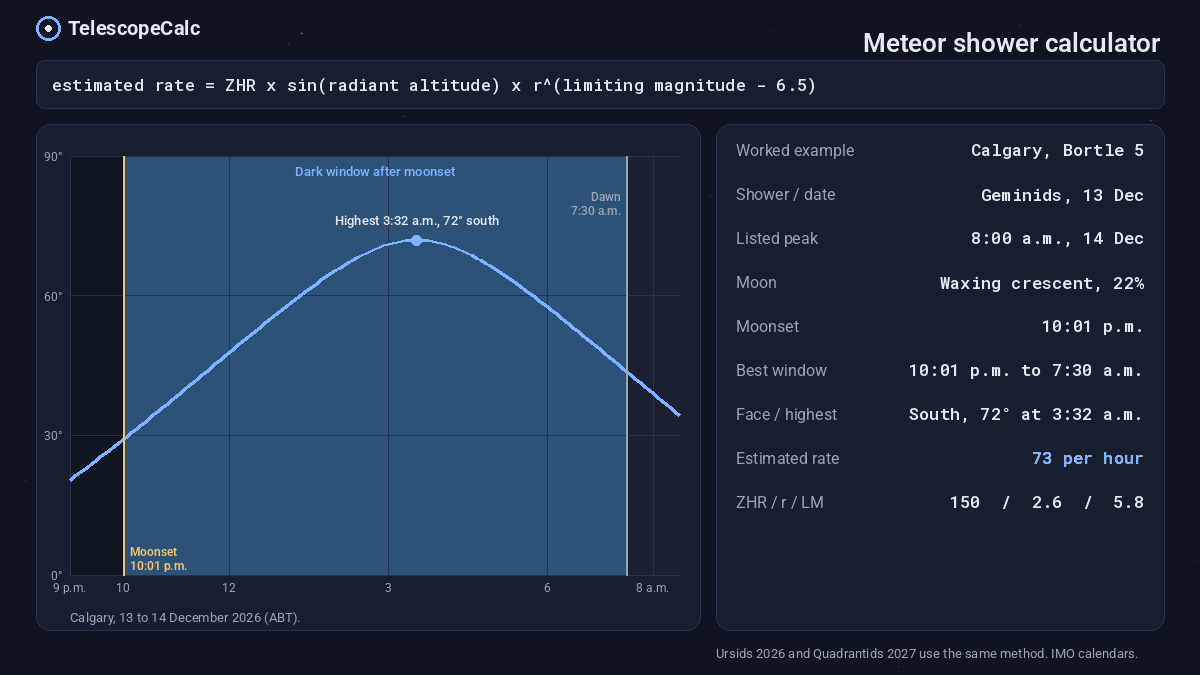
ZHR is the zenithal hourly rate, a standard rate for a radiant overhead under a limiting magnitude of +6.5. When the radiant is lower, you see fewer meteors. A brighter sky (a lower limiting magnitude) also cuts the rate. The population index r is 2.6 for the Geminids, 2.8 for the Ursids and 2.1 for the Quadrantids, as listed by the IMO. The rate is zero when the radiant is below the horizon. This figure uses the peak ZHR, so the real rate is lower away from the maximum.
Sun and moon times
The sun and moon positions use the low-precision algorithms in Jean Meeus, Astronomical Algorithms, 2nd edition (Willmann-Bell, 1998), chapters 12, 15, 25 and 47. Moonrise and moonset use the apparent upper limb, with a standard refraction term. Times are shown in your browser's time zone.
The best window starts at the later of the end of evening astronomical twilight (sun 18 degrees below the horizon) and moonset, and ends at the earlier of the start of morning astronomical twilight and moonrise. If the moon is up all night, the window is still the astronomical night, with a note that faint meteors will be harder to see.
Sources
- International Meteor Organization, Meteor Shower Calendar 2026 (J. Rendtel, ed.)
- International Meteor Organization, Meteor Shower Calendar 2027 (J. Rendtel, ed.)
- International Meteor Organization: meteor shower calendar
Jean Meeus, Astronomical Algorithms, 2nd edition (Willmann-Bell, 1998), chapters 12, 15, 25 and 47.
Common questions
What time is the Geminid peak where I live?
The IMO lists the 2026 Geminid maximum at 14h UT on 14 December, which is 8:00 a.m. on 14 December in UTC-6. Enter your latitude, longitude and date. The times in the results use your browser's time zone, and the best viewing window is the hours after evening darkness or moonset, until dawn or moonrise.
Which direction should I face?
Face the compass direction shown in the results. That is the direction of the radiant, the point the meteors appear to come from. Meteors can appear anywhere in the sky. Looking about 30 to 60 degrees away from the radiant often shows longer trails than looking straight at it.
Where do the shower dates and rates come from?
Peak times, zenithal hourly rates and radiant positions are taken from the International Meteor Organization calendars for 2026 and 2027. The Geminid radiant is given as right ascension 112 degrees (7h 28m) and declination +33 degrees.
Is my location sent to the site?
No. If you press Use my location, the coordinates stay in your browser. You can type a latitude and longitude instead.